
Key Facts: Conservation Area Extensions in London (2026)
Extending a property in a London conservation area costs 15 to 30% more than an equivalent extension on an unrestricted site, due to material requirements, additional planning work, and longer determination timescales. Most single-storey rear extensions in conservation areas require a full planning application rather than permitted development, and the council will apply detailed scrutiny to materials, roof form, and the visual relationship between the new and existing building.
Key differences from a standard extension: full planning application usually required; materials must typically match or complement the existing building; a design and access statement is almost always needed; conservation officer input adds time and sometimes cost to the process.
These figures include: construction (shell and fit-out), professional fees (architect, structural engineer, party wall surveyor), design and access statement, and VAT at 20%.
These figures exclude: kitchen and bathroom units and appliances (costed separately below), furniture, and landscaping.
| Extension Type | Conservation Area Cost Per m² (excl. VAT) | Typical Total Project Cost |
|---|---|---|
| Rear (single storey) | £3,500 – £5,200 | £75,000 – £160,000 |
| Side return | £4,000 – £5,500 | £60,000 – £115,000 |
| Wraparound | £3,800 – £5,500 | £105,000 – £195,000 |
| Double storey | £3,200 – £4,800 | £140,000 – £220,000+ |
| Loft conversion (conservation area) | £3,500 – £5,000 | £60,000 – £120,000 |
Cost ranges are indicative estimates for 2026, compiled from published industry data including the RICS Building Cost Information Service (BCIS), the HomeOwners Alliance house extension cost guide, and My/Architect’s completed project data across London conservation areas. Ranges reflect mid-range to premium specifications and vary by borough, site conditions, and project complexity. These figures should be treated as planning benchmarks.
For a project-specific estimate, book a free consultation with My/Architect now.
What Is a Conservation Area and Does It Affect My Extension?
A conservation area is a designated zone of special architectural or historic interest, identified by the local planning authority as an area whose character and appearance it is desirable to preserve or enhance. In London, conservation area designations are made by each borough council under the Planning (Listed Buildings and Conservation Areas) Act 1990.
There are over 1,000 conservation areas in Greater London, covering a significant proportion of the capital’s Victorian, Edwardian, and Georgian residential streets. In inner London boroughs such as Islington, Camden, Hackney, Kensington and Chelsea, and Hammersmith and Fulham, the majority of residential streets in the most sought-after neighbourhoods sit within a designated conservation area.
If your property sits within a conservation area, the designation affects your extension in three important ways.
First, permitted development rights are reduced. Works that would be automatically approved on an unrestricted property — such as a single-storey rear extension of up to 4 metres on a detached house — may require a full planning application in a conservation area. Cladding the exterior of your house in stone, render, or timber, which is permitted development on a standard property, is not permitted in a conservation area without planning permission.
Second, the planning authority will apply additional scrutiny to any application you submit. The council’s conservation officer will be consulted, and the design, materials, and relationship between the new extension and the existing building will be assessed against the area’s character appraisal and management plan.
Third, the materials and details available to you are often constrained. Reclaimed London stock bricks, lime mortar, natural slate, and timber windows may be required in place of modern alternatives. These materials are more expensive and require more skilled labour to install, which is why conservation area extensions consistently cost more per square metre than equivalent work on unrestricted sites.
None of this means you cannot extend. My/Architect has delivered extensions across London’s most tightly controlled conservation areas, from Canonbury in Islington to Belsize Park in Camden. The key is understanding the rules, working with the grain of the designation, and presenting a scheme that the council can support.
How to Check If Your Property Is in a Conservation Area
The quickest way to confirm your conservation area status is to use your borough council’s online planning map. Most London councils publish an interactive mapping tool that allows you to enter your postcode and see all planning designations affecting your property.
Historic England also maintains a national heritage list for England that includes conservation area boundaries, though borough-level mapping tools are generally more up to date for boundary changes.
If you are unsure, your architect can confirm the designation as part of the initial site and planning assessment, and will obtain the relevant conservation area appraisal document to inform the design approach from the outset.
Conservation Area Planning Rules for Extensions
The planning rules that apply to extensions in conservation areas differ from those on unrestricted residential sites in several important respects. Understanding these differences before you begin design work saves time, cost, and the frustration of submitting a scheme that does not reflect the local authority’s expectations.
The Duty to Preserve or Enhance
Section 72 of the Planning (Listed Buildings and Conservation Areas) Act 1990 places a statutory duty on local planning authorities to pay special attention to the desirability of preserving or enhancing the character or appearance of conservation areas when exercising their planning functions. In practice, this means that any application for works within a conservation area will be assessed not just against general planning policy, but against this specific duty.
An extension that would be acceptable on a standard residential site may be refused in a conservation area if it is judged to harm the character of the area. Conversely, a well-designed scheme that genuinely enhances the setting can sometimes achieve planning consent for works that might otherwise be marginal.
This is why the quality of the design and the quality of the planning submission matter so much in conservation areas. A strong design and access statement that explains how the proposal responds to the conservation area appraisal, references the relevant local and national policy framework, and demonstrates the applicant’s understanding of the area’s special character will always give a scheme a better chance of approval than a bare application.
Conservation Area Appraisals and Management Plans
Every designated conservation area should have a conservation area appraisal: a document prepared by the council that describes the area’s special character and appearance, identifies the buildings, spaces, and features that contribute to that character, and sets out the design principles that new development should follow.
Many London boroughs also publish a conservation area management plan alongside the appraisal, which translates the character description into specific design guidance for extensions, alterations, and new build within the area.
These documents are essential reading before you begin designing an extension in a conservation area. They are publicly available on each borough council’s planning pages, and a competent architect will obtain and review them as a matter of course before producing any design work.
The appraisal will typically identify: the predominant building materials (brick type, mortar colour, roof material); the characteristic roof forms and ridge heights; the typical window proportions and relationship to wall area; the treatment of front gardens, boundaries, and the street edge; and any buildings or features that are identified as making a positive contribution to the area’s character.
Your extension will be assessed against all of these criteria, which is why an architect who knows the relevant borough well, and who has navigated that council’s conservation team before, is a significant advantage.
Article 4 Directions
In many inner London conservation areas, the local planning authority has made an Article 4 direction. This is a formal designation that removes specified permitted development rights from properties within the defined area, meaning that works which would otherwise be permitted development require a full planning application.
Article 4 directions in London conservation areas commonly remove permitted development rights for: side and rear extensions; roof alterations including dormers and rooflights; changes to external materials including render, cladding, and roofing; and alterations to windows and doors on principal elevations.
The effect is that virtually any external alteration to a property in an Article 4 conservation area requires planning permission. This is not a barrier to extending, but it does mean that the planning process cannot be bypassed, and that the design must be developed with the council’s expectations firmly in mind from the outset.
Your architect should confirm whether an Article 4 direction applies to your property as part of the initial planning assessment. In some boroughs, such as Islington and Camden, Article 4 coverage is so extensive that it can be assumed to apply to most residential properties in the inner areas.
Permitted Development in Conservation Areas: What Is and Isn’t Allowed
Permitted development rights allow certain works to be carried out without a formal planning application. In conservation areas, these rights are significantly curtailed compared to unrestricted residential sites. The table below summarises what is and is not permitted development for a typical residential property in a London conservation area, absent an Article 4 direction.
| Works Type | Standard Residential Site | Conservation Area (no Article 4) | Conservation Area (with Article 4) |
|---|---|---|---|
| Single-storey rear extension (up to 4m detached / 3m other) | Permitted development | Permitted development | Planning application required |
| Side extension | Permitted development (conditions apply) | Planning application required | Planning application required |
| Roof extension / dormer (principal elevation) | Not permitted development | Not permitted | Not permitted |
| Roof extension / dormer (non-principal elevation) | Permitted development | Not permitted | Not permitted |
| Rooflights (principal elevation) | Permitted development | Not permitted | Not permitted |
| Cladding exterior walls | Permitted development | Not permitted | Not permitted |
| Satellite dish (principal elevation) | Permitted development | Not permitted | Not permitted |
| Front garden hard standing | Permitted development (permeable only) | Planning application required | Planning application required |
The practical consequence for most London homeowners is that any meaningful extension to a property in a conservation area will require a full planning application, either because the works fall outside permitted development in conservation areas even without an Article 4 direction, or because an Article 4 direction has removed the remaining rights.
This should not discourage you from extending. It does mean that the quality of your planning submission, the strength of your design argument, and the experience of your architect in working with that particular council all become significantly more important than they would be on a standard permitted development project.
Prior Approval for Larger Home Extensions
The Larger Home Extension scheme (sometimes called the Householder Prior Approval scheme) allows single-storey rear extensions of up to 6 metres on semi-detached and terraced houses, and up to 8 metres on detached houses, subject to a neighbour notification process. This scheme is available in conservation areas, subject to the same conditions that apply on unrestricted sites.
However, it does not override Article 4 directions. If an Article 4 direction has removed the underlying permitted development right for the extension, the Larger Home Extension scheme cannot be used, and a full planning application is required.
Even where the Prior Approval route is technically available, many architects working in conservation areas prefer to proceed via a full planning application. A planning consent provides a stronger legal basis for the works and is more likely to satisfy mortgage lenders, solicitors, and future buyers than a prior approval determination.
How Much Does a Conservation Area Extension Cost?
A conservation area extension in London costs 15 to 30% more than an equivalent extension on an unrestricted site. On top of the standard London premium described in our house extension costs guide, the conservation area designation adds its own cost layer driven by four factors: material requirements, more extensive planning work, longer determination timescales, and the higher skill level required from contractors working with traditional materials.
The conservation area premium is not uniform. It varies depending on how prescriptive the relevant conservation area appraisal is about materials and form, and how experienced the local contractor market is in working with traditional construction methods. In areas where reclaimed London stock brick, lime mortar, and timber joinery are routinely required, the premium sits at the upper end of the range.
Where the Additional Cost Comes From
Materials. Reclaimed London stock bricks cost significantly more than modern equivalents — typically £1.50 to £3.00 per brick versus £0.30 to £0.80 for a standard new-build brick — and require more skilled labour to lay because the variable sizes and soft faces of reclaimed units demand greater care. Lime mortar, specified in many conservation areas to match the flexibility and appearance of historic joinery, is more expensive than standard cement mortar and takes longer to cure, adding to the programme length. Natural slate for roofing is approximately three to four times the cost of concrete interlocking tiles.
Joinery. Conservation area extensions frequently require timber windows and doors rather than aluminium or uPVC alternatives. Bespoke timber joinery, particularly where profiles must match the existing building, can cost two to three times the equivalent in powder-coated aluminium.
Professional fees. A planning application in a conservation area requires a design and access statement, and frequently a heritage impact assessment. The preparation of these documents adds to the architect’s fee, typically £1,500 to £3,500 on top of a standard householder application. Conservation officers add a consultee whose comments must be addressed, sometimes requiring the design to be revised and resubmitted, which adds programme time and professional cost.
Contractor experience. Not every builder has experience working with lime mortar, reclaimed brick, or traditional roof details. Those who do command a premium for that expertise, and rightly so. The cost of getting traditional details wrong — failed pointing, cracked render, poorly matched brick — is substantially higher than the cost of doing it correctly first time with a specialist contractor.
Conservation Area Extension Costs by Type
| Extension Type | Standard London Cost Per m² | Conservation Area Cost Per m² | Typical Additional Cost |
|---|---|---|---|
| Rear (single storey) | £3,000 – £4,500 | £3,500 – £5,200 | +£8,000 – £20,000 |
| Side return | £3,500 – £5,000 | £4,000 – £5,500 | +£5,000 – £12,000 |
| Wraparound | £3,200 – £4,800 | £3,800 – £5,500 | +£10,000 – £25,000 |
| Double storey | £2,800 – £4,200 | £3,200 – £4,800 | +£15,000 – £30,000 |
Planning Fees and Additional Professional Costs
From 1 April 2026, the householder planning application fee is £548 following annual CPI indexation of 3.8%. This applies equally to applications in conservation areas as on unrestricted sites.
Additional professional costs specific to conservation area applications include:
Design and access statement: £800 to £2,000, depending on complexity and the level of heritage context required.
Heritage impact assessment: £1,500 to £4,000. Required for more complex applications, particularly those involving extensions to buildings that make a positive contribution to the conservation area, or where the proposed works are close to the boundary of the designated area.
Pre-application advice: Most London borough planning departments offer a paid pre-application advice service. For conservation area applications, this is strongly recommended. Fees vary by council, typically £200 to £600 for a householder meeting, but the investment consistently saves more than it costs by identifying the council’s position before the formal application is submitted.
Design Principles: What Makes a Conservation Area Extension Successful
The question of how to design an extension in a conservation area is one that divides architectural opinion. Two broad schools of thought exist: the contextual approach, which seeks to match or closely reference the character of the existing building; and the contrasting approach, which uses clearly contemporary design to create a legible distinction between old and new.
Both are valid. Both can achieve planning consent. The key is understanding which approach a particular conservation area’s appraisal and management plan favours, and which the local planning authority has historically supported.
The Contextual Approach
A contextual extension reads as an extension of the existing building. It uses matching or complementary materials, maintains the scale and rhythm of the host structure, and makes no attempt to announce itself as something separate from what came before.
This approach is most appropriate where the conservation area appraisal emphasises the uniformity of the street scene, the importance of material consistency, and the visual dominance of the existing building stock. It is common in Georgian and early Victorian conservation areas where the original buildings are formal in character and the relationship between properties is closely regulated.
In practice, a contextual extension uses: reclaimed brick to match the existing fabric; lime mortar to match the original pointing style; natural slate or plain clay tiles on the roof; timber windows with matching profiles to the existing; and a roof form that echoes the host building’s eaves height and pitch.
The risk of a purely contextual approach is that it can read as pastiche if executed without sufficient skill. The difference between a contextual extension that is convincingly integrated and one that looks like a poorly matched addition lies almost entirely in the quality of the design detailing and the accuracy of the material specification.
The Contemporary Approach
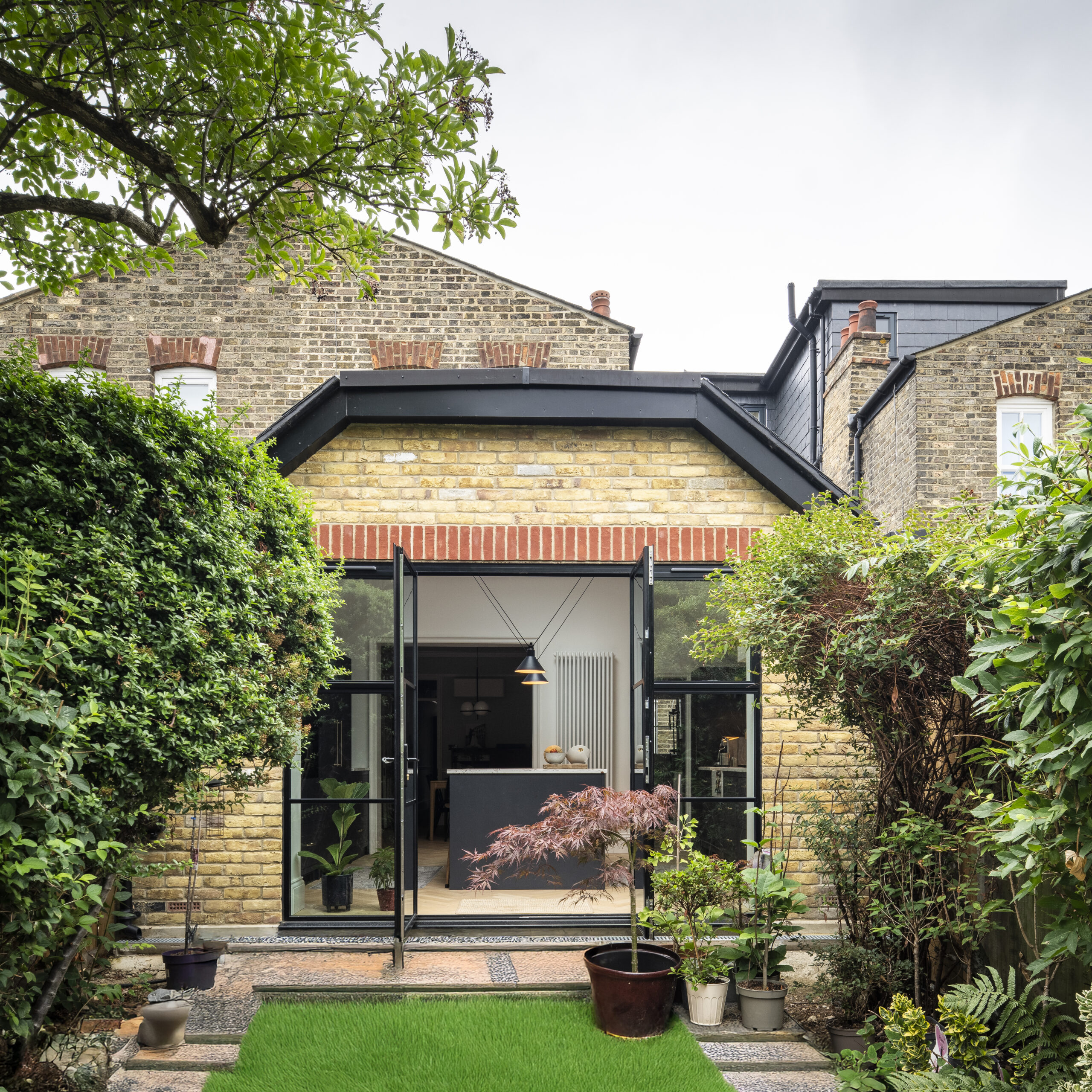
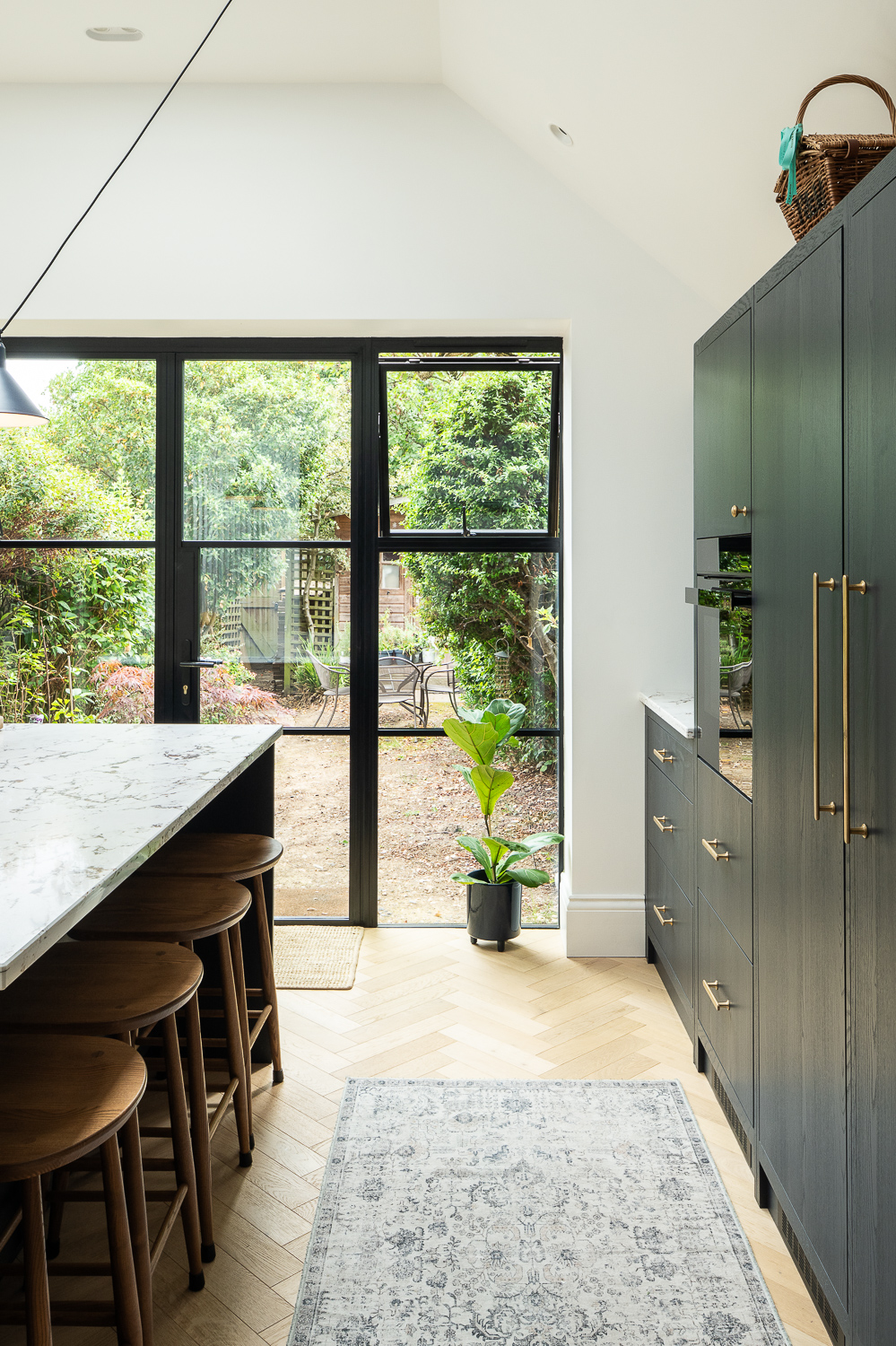
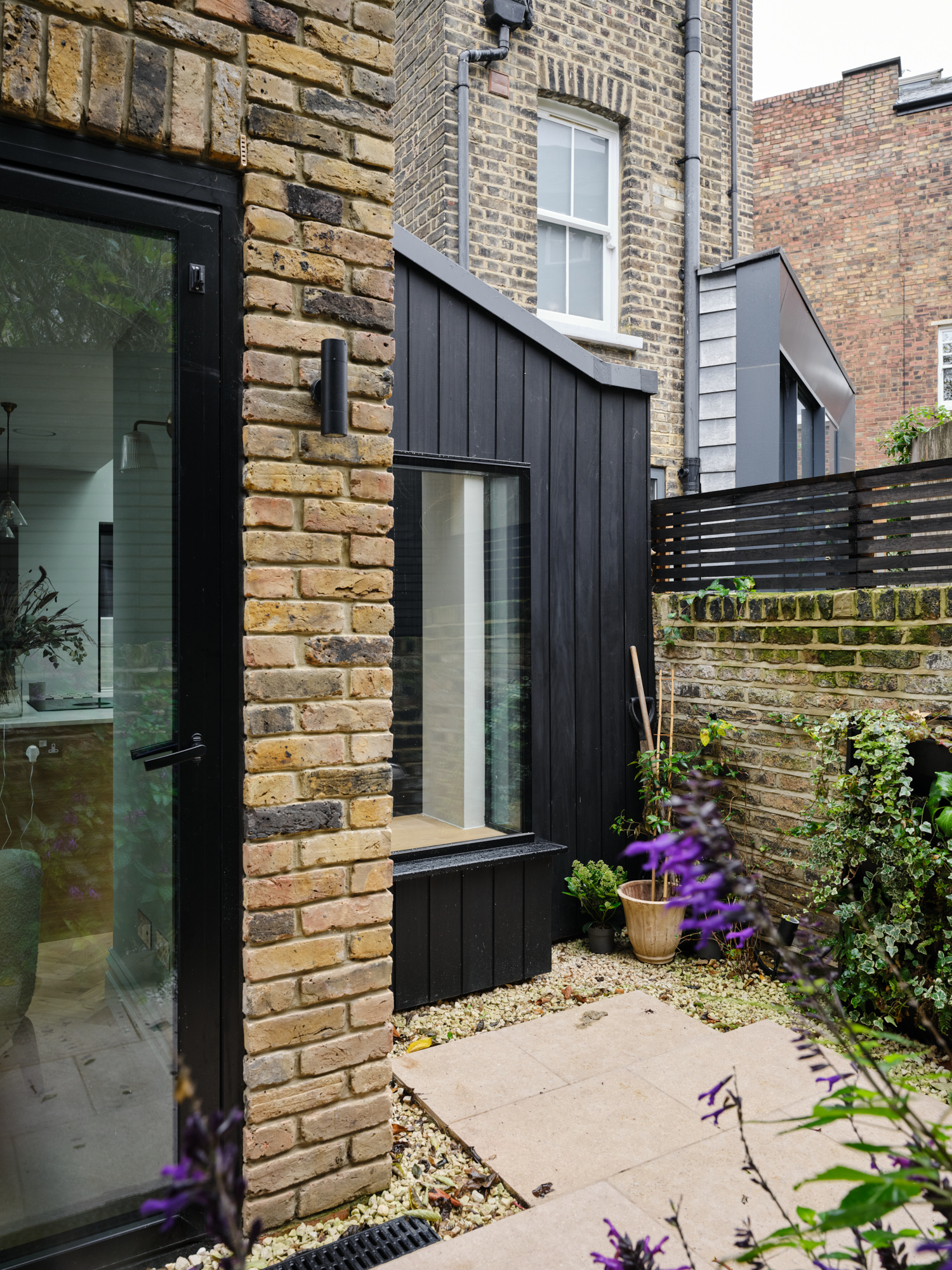
A contemporary extension makes no attempt to replicate the existing building. Instead, it uses modern materials and forms — zinc or standing seam metal roofing, engineered timber cladding, minimal-frame glazing — to create a clear but harmonious contrast between old and new.
This approach is endorsed by Historic England’s own design principles for conservation areas, which state that new development should be of its own time while respecting the scale, massing, and grain of the existing area. Many of London’s conservation officers actively prefer a clearly contemporary addition over an imitative one, on the grounds that an honest contemporary design is more truthful about what it is and when it was built.
A contemporary approach works best when the new element is set back from the existing building line, positioned at the rear where it does not compete with the principal elevation, and designed with the same care for proportion, scale, and material quality as the existing building commands.
At My/Architect, we take a case-by-case position, letting the conservation area appraisal, the character of the existing building, and the council’s established precedents guide the approach. The best conservation area extensions are not dogmatic — they are designed to work.
Proportion, Scale, and Subordination
Regardless of whether the approach is contextual or contemporary, three principles apply to almost every successful conservation area extension.
The extension should be subordinate to the existing building. It should be clearly secondary in scale, not competing with the host for visual dominance. As a rule of thumb, the ridge height of the extension should be at or below the eaves of the existing house, and the footprint should not overwhelm the remaining garden.
The proportions of openings in the new extension should respond to the rhythm of windows and doors in the existing building. Conservation area appraisals frequently identify the ratio of solid to void as a key character element. An extension that introduces large, unbroken panes of glass on a street of narrow-sash Victorian windows may struggle at the planning stage regardless of its quality.
The roof form matters. Flat roofs, while acceptable in many conservation areas when positioned at the rear and not visible from the street, can attract objection where the appraisal identifies pitched roofs as a defining characteristic of the area. Your architect should review the precedent for flat-roofed extensions in the specific area before committing to the roof form at the concept stage.
Materials, Details, and Specifications
Material selection is the most visible and most scrutinised aspect of a conservation area extension. Getting it right is the difference between an extension that enhances the existing building and one that fights against it.
Brick
London’s Victorian and Edwardian residential areas are predominantly built in London stock brick: a distinctive yellow-grey brick fired from the Kentish clay that underlies much of the Thames basin. The colour, texture, and bond pattern of this brick define the character of streets across Islington, Hackney, Camden, and Wandsworth.
Conservation area appraisals in these boroughs typically require extensions to use matching or complementary brick. For the closest visual match, this means reclaimed London stock brick, salvaged from demolition projects and sourced through specialist reclamation yards. Reclaimed brick is expensive — typically £1.50 to £3.00 per unit — but the visual result of a well-matched reclaimed brick extension is markedly better than any modern equivalent.
Where reclaimed brick is not available in sufficient quantity, some conservation officers will accept a carefully selected new brick that closely matches the colour, texture, and size of the original. Your architect should obtain council approval for a proposed brick before ordering, typically by providing a physical sample to the planning department.
Mortar
The mortar between the bricks is as visually significant as the bricks themselves. Historic London brickwork used lime-based mortars, which are softer and more flexible than modern cement mortars and which weather to a distinctive pale appearance.
In many conservation areas, lime mortar is specified not only for its appearance but for its functional compatibility with the existing structure. Repointing historic brickwork with hard cement mortar forces the stresses of thermal movement into the bricks themselves, causing spalling and long-term damage. Lime mortar, by contrast, is sacrificial by design: it takes the strain and can be repointed without damaging the surrounding brick.
Conservation officers in boroughs with a high concentration of Victorian stock brick, including Islington and Camden, will frequently specify lime mortar as a planning condition. Your contractor must be experienced in mixing and applying lime mortars correctly, as the curing process differs significantly from cement and errors are difficult and costly to reverse.
Roofing Materials
The roof covering of an extension in a conservation area must be carefully considered. Natural Welsh slate is the most commonly specified material for pitched-roof extensions in areas where the existing stock is slate-roofed. Modern concrete interlocking tiles are rarely acceptable in conservation areas, as they read as visually incompatible with the existing roofscape.
For flat-roofed extensions positioned at the rear, zinc, lead, or high-quality single-ply membrane roofing systems are generally acceptable. The choice between them will depend on the conservation area appraisal, the council’s precedents, and the architect’s specification.
Windows, Doors, and Glazing
Timber windows are the default specification in most London conservation area appraisals. The profile of the window — the width of the frame, the depth of the glazing bars, the sill and head detail — should respond to the proportions of the existing windows in the host building.
Modern aluminium windows are accepted by some conservation officers, particularly for rear extensions that are not visible from the public highway, provided the profile is slim and the colour is carefully chosen. However, conservation area applications proposing aluminium windows on any elevation visible from the street will face greater scrutiny than those specifying timber.
uPVC windows are not acceptable in conservation areas in most London boroughs. Their profile, material appearance, and association with low-quality residential alteration make them incompatible with the design standards that conservation area designation implies.
Glazing is an area where contemporary conservation area extensions can make a strong design statement. Minimal-frame glazing systems, structural glass rooflights, and full-width sliding or bifold doors to the garden are accepted in many conservation areas when positioned at the rear, provided the overall design quality is high and the scale of the glazing is appropriate to the setting.
Insulation and Part L Compliance
Conservation area extensions must meet the same Part L Building Regulations energy performance requirements as any other extension. The U-value targets introduced in the 2022 uplift apply: walls at 0.18 W/m²K, roofs at 0.16 W/m²K, floors at 0.18 W/m²K, and windows and doors at 1.4 W/m²K or better.
Meeting these requirements with traditional materials adds complexity. A solid brick wall built in reclaimed stock brick will not achieve the required U-value without an insulated inner skin, which means the wall build-up is inevitably thicker than a modern cavity wall construction. This must be factored into the floor plan from the outset, as the additional thickness can reduce internal floor area.
Timber windows can achieve the required thermal performance with modern double-glazed units, provided the frame sections are carefully detailed to accommodate the glazing unit depth. Your architect and structural engineer should confirm the wall and roof build-up at the technical design stage to ensure Part L compliance does not require any compromise to the external appearance.
The Planning Application Process in a Conservation Area
The planning application process for a conservation area extension follows the same statutory framework as any householder application, but with additional layers of consultation, scrutiny, and documentation. Understanding the process in advance allows you to manage programme expectations and avoid the most common causes of delay.
Pre-Application Advice
Before submitting a formal application in a conservation area, it is almost always worth engaging the council’s pre-application advice service. This paid service allows you to share your design proposals with a planning officer and, in most cases, the conservation officer, and to receive formal written feedback before committing to a full application.
Pre-application advice is not binding. The council can take a different view when the formal application is submitted. But it is the most reliable way to identify any fundamental objections early, before the design has been fully developed and drawn up. On a conservation area project, where the cost of redesign is higher and the stakes of a refusal are greater, the investment in pre-application advice almost always pays for itself.
Most London boroughs charge between £200 and £600 for a pre-application meeting and written response at the householder level. Some boroughs, including Camden and Islington, offer different tiers of service with different response times and levels of detail.
The Planning Application
A full householder planning application for a conservation area extension requires, as a minimum: completed application form and site ownership certificate; location plan and site plan; existing and proposed drawings (floor plans, elevations, and sections); design and access statement; photographs of the existing property and its context; and the application fee (£548 from April 2026).
For more complex applications, the council may also require: a heritage impact assessment; a tree survey and arboricultural impact assessment if there are trees on or adjacent to the site; a daylight and sunlight report if the extension could affect neighbouring properties’ access to natural light; and a sustainability statement if the council’s local plan policies require one.
The statutory determination period for a householder planning application is 8 weeks. However, applications in conservation areas frequently take longer in practice, as the conservation officer consultation adds time to the process. Councils can and do request extensions to the determination period for more complex applications, and applicants are asked to agree to these extensions as a condition of continued consideration.
Conservation Officer Consultation
The conservation officer is a specialist officer within the planning department whose role is to advise on applications affecting the historic environment. They are consulted on all applications in conservation areas, and their recommendation carries significant weight in the planning officer’s assessment.
Conservation officers are not obstacles. The best approach is to treat them as knowledgeable specialists whose input can improve the design. An architect who has an established working relationship with the conservation officers at the relevant borough will often be able to anticipate their concerns and address them in the design before the application is submitted.
Where the conservation officer raises objections, the planning officer will typically write to the applicant requesting a response. This may require revised drawings or additional information, which extends the determination period. On contested applications, a negotiated outcome is often achievable with the right design arguments and a willingness to refine the scheme in response to the council’s specific concerns.
Appeals
If a conservation area application is refused, the applicant has the right to appeal to the Planning Inspectorate within 12 weeks of the decision. Appeals are determined by an inspector appointed by the Secretary of State, independent of the local planning authority.
Appeals are time-consuming — typically 6 to 12 months for a householder appeal determined by written representations — and the outcome is uncertain. In practice, most conservation area refusals are better resolved through pre-application negotiation before resubmission than through a formal appeal. Your architect should advise you on the merits of an appeal versus a revised application on the basis of the specific reasons for refusal.
Conservation Areas by London Borough
London’s conservation areas are not evenly distributed. Inner London boroughs have the highest concentration, and the design standards, material requirements, and planning culture vary meaningfully between councils. The borough-level summaries below reflect My/Architect’s direct experience working across these areas.
Camden
Camden has over 40 designated conservation areas, covering large parts of Belsize Park, Hampstead, Kentish Town, Primrose Hill, Dartmouth Park, and Bloomsbury. The borough’s conservation area appraisals are detailed and consistently applied, and the council’s conservation team is experienced and well-resourced.
Material requirements in Camden conservation areas are among the strictest in London. Reclaimed London stock brick, lime mortar, and natural slate are routinely specified. The borough’s design quality expectations from the local property market are high, which means that well-designed extensions consistently achieve consent, but poorly designed ones face significant resistance.
Pre-application advice in Camden is strongly recommended. The council offers a paid householder pre-application service that provides written feedback from a planning officer and conservation officer. Determination timescales for conservation area applications typically run to 10 to 12 weeks.
My/Architect works regularly across Camden’s conservation areas, including projects in Dartmouth Park, Belsize Park, and Kentish Town.
Islington
Islington has one of the highest conservation area densities of any London borough. The council’s conservation area pages list over 30 designated areas, including Canonbury, Barnsbury, Highbury Fields, Clerkenwell, and Thornhill Square. Article 4 directions are in place across the majority of the borough’s residential areas.
The dominant property type is the narrow Victorian mid-terrace, and the side return extension is the most requested extension type across the borough. Islington’s conservation officers are experienced in assessing side return proposals and have established clear precedents for acceptable materials and forms.
The borough’s planning team runs a paid pre-application service. Given the prevalence of Article 4 directions and the complexity of conservation area requirements in Islington, this service is essentially indispensable for any meaningful extension project.
My/Architect has completed multiple conservation area projects across Islington, including side return and rear extensions in Canonbury and Barnsbury.
Listed buildings are subject to a separate and stricter regime. See extending a listed building in Islington.
Hackney
Hackney has designated conservation areas in De Beauvoir Town, Clapton, London Fields, Stoke Newington, and several other residential neighbourhoods. The borough’s planning department is generally pragmatic, and determination timescales tend to be more reliable than in some inner London boroughs.
Hackney’s Victorian terraced streets generate strong demand for side return and rear extensions, and the borough has a well-established body of precedent for contemporary extensions within conservation areas. Architects with experience of Hackney’s planning culture will be familiar with the acceptable approaches.
Find out more about My/Architect’s work in Hackney.
Kensington and Chelsea
Kensington and Chelsea has extensive conservation area coverage across virtually its entire residential area, encompassing some of the most tightly controlled designations in London. The council’s conservation area pages list over 70 designated areas, covering Holland Park, Notting Hill, Chelsea, South Kensington, and Kensington itself.
Specification requirements in Kensington and Chelsea conservation areas are the highest in London, reflecting both the quality of the existing building stock and the expectations of the local property market. Extensions are assessed with meticulous attention to material quality, proportions, and the relationship to the host building.
The council’s conservation team is active and influential. Pre-application advice is essential on any project in this borough, and the cost premium for conservation area work is at the upper end of the London range. Budget £4,000 to £6,000+ per m² for a mid-range to premium extension in this borough.
Hammersmith and Fulham
Hammersmith and Fulham has conservation areas across Fulham, Brook Green, Brackenbury Village, and parts of Hammersmith itself. The borough’s conservation framework sets out the design principles for extensions within each designated area.
Fulham’s Victorian terraced streets generate significant demand for side return and rear extensions, and the borough has a well-developed planning framework for assessing these. Determination timescales are broadly in line with the London average.
Read more about My/Architect’s projects in Hammersmith and Fulham.
Wandsworth
Wandsworth has conservation areas in Battersea, Balham, Tooting, Putney, and around Wandsworth Common and Clapham Junction. The borough’s planning department is generally efficient, and the broader range of property types in the borough, including larger semi-detached and detached houses, means a wider variety of extension types are in demand.
Conservation area requirements in Wandsworth are applied consistently, though the borough’s planning culture is generally considered more pragmatic than some of the inner London councils. Cost ranges for conservation area extensions in Wandsworth sit at the lower end of the London premium range.
Find out more about My/Architect’s work in Wandsworth.
Other London Boroughs
Conservation areas exist in every London borough. Outer boroughs including Richmond, Ealing, Barnet, and Bromley all have designated areas with varying levels of design scrutiny. In these locations, the conservation area premium over a standard extension tends to sit at the lower end of the 15 to 30% range, reflecting both the slightly more permissive planning culture and the lower baseline construction costs compared to inner London.
Architect and Professional Fees for Conservation Area Extensions
Professional fees on a conservation area extension in London typically sit at 15 to 20% of the construction cost, compared to 12 to 18% for an equivalent project on an unrestricted site. The additional cost reflects the greater design effort required, the more extensive planning submission, and the higher probability of an iterative design process involving pre-application advice and conservation officer engagement.
What the Architect Fee Covers
The architect’s fee for a full service on a conservation area extension covers: initial site and planning analysis, including review of the conservation area appraisal and any Article 4 directions; concept design and design development; pre-application engagement with the council if required; preparation of all planning drawings and the design and access statement; planning application submission and management; Building Regulations application and technical drawings; contractor procurement and tender analysis; and construction monitoring through to practical completion and sign-off.
On a £120,000 conservation area extension, a full architect service at 12% represents £14,400 in fees. On a more complex conservation area scheme, where pre-application advice, heritage impact assessment, and a more involved planning process are required, the total professional fee can reach 18 to 22% of the construction cost.
Other Professional Costs
Structural engineer: £1,200 to £3,500. Required on all extensions involving structural openings, new foundations, or steelwork. Costs are similar to unrestricted sites.
Party wall surveyor: £800 to £1,500 per adjoining neighbour. The Party Wall etc. Act 1996 requirements are the same in conservation areas as on standard residential sites. On a mid-terrace property, party wall costs can reach £3,000 to £4,500 for two adjoining neighbours.
Heritage consultant: £1,500 to £4,000. Required on more complex applications where a heritage impact assessment is necessary. Not needed on straightforward single-storey rear extensions in conservation areas, but may be required for extensions that are more visible from the street or that involve more significant alterations to the fabric of the existing building.
Building Control: £600 to £1,800. All extensions require Building Regulations approval. Conservation area status does not change the Building Regulations requirements, but the more complex construction detailing involved in conservation area work can extend the Building Control inspection programme.
Pre-application advice: £200 to £600. Paid directly to the council. An investment that almost always delivers a positive return in time saved and refusals avoided.
For homeowners who want to verify their architect’s credentials, the Architects Registration Board maintains the statutory register of all architects licensed to practise in the UK, and the RIBA chartered membership register identifies architects who have met the RIBA’s additional professional standards.
Conservation Area Extension FAQs
Do I need planning permission for an extension in a conservation area?
In most cases, yes. Side extensions always require a planning application in a conservation area. Single-storey rear extensions may fall within permitted development in some conservation areas, but Article 4 directions — which are common across inner London boroughs — remove this right and require a full application for all meaningful external works. Always confirm with your architect or local planning authority before starting any design work.
How long does a conservation area planning application take?
The statutory determination period is 8 weeks, but conservation area applications regularly take 10 to 14 weeks in practice due to the conservation officer consultation and the additional information frequently required. Where pre-application advice has been sought and the design has been developed in response to the council’s feedback, determination within the standard 8-week period is more likely.
What materials do I have to use for a conservation area extension?
The required materials depend on the specific conservation area appraisal and the council’s published design guidance. In most inner London conservation areas built from London stock brick, reclaimed brick and lime mortar are required for extensions visible from the street. Roof materials are typically natural slate or plain clay tiles. Timber windows are preferred on principal elevations. For rear extensions not visible from the public highway, conservation officers are often more flexible, and contemporary materials including zinc, engineered timber, and minimal-frame glazing can be acceptable.
Can I have a flat roof on a conservation area extension?
A flat roof is acceptable in many London conservation areas for single-storey rear extensions that are not visible from the street or any public viewpoint. Where the conservation area appraisal identifies pitched roofs as a defining characteristic, a flat roof may face greater scrutiny even at the rear. Pre-application advice from the council is the most reliable way to confirm what roof form will be acceptable before committing to the design.
Will a conservation area extension add value to my property?
A well-designed and well-executed conservation area extension can add significant value to a property, in many cases more than an equivalent extension in an unrestricted area. Properties in London conservation areas command a price premium in the open market, and a thoughtfully designed extension that enhances rather than compromises the property’s character supports that premium. Research from Knight Frank consistently identifies conservation area location as a positive value driver in the London residential market.
Can my neighbour object to my conservation area extension?
Yes. Neighbours are formally consulted as part of the planning application process, and any representations they submit are considered by the planning officer. Objections that raise genuine planning considerations such as loss of light, overlooking, or impact on the street scene carry more weight than those based on personal preference. Your architect can advise on the likely objections for your specific proposal and how to address them in the design and access statement.
Is it worth getting pre-application advice before submitting?
For conservation area extensions, yes — almost without exception. Pre-application advice allows you to identify the council’s position on key design questions before committing to a full set of drawings, reduces the risk of a refusal, and can significantly shorten the formal determination period. The cost, typically £200 to £600, is a fraction of the professional fees involved in redesigning a refused scheme or pursuing an appeal.
Do Building Regulations apply differently in conservation areas?
Building Regulations apply in the same way regardless of conservation area status. All extensions must meet current energy efficiency, structural, and safety requirements. The challenge in conservation areas is achieving Part L energy performance targets with traditional materials, which may require a thicker wall build-up or more careful detailing of junctions. Your architect and structural engineer will address this at the technical design stage.
Next Steps: Speak to a Conservation Area Architect
Extending in a conservation area is more complex than extending on an unrestricted site, but it is far from impossible. The constraints of the designation, approached with the right design thinking and the right knowledge of the relevant borough, produce some of the best residential architecture in London.
My/Architect has delivered extensions and alterations across London’s most tightly controlled conservation areas, including Canonbury, Barnsbury, Belsize Park, Fulham, De Beauvoir Town, and Dartmouth Park. We know the conservation area appraisals, the design expectations, and the planning cultures of the boroughs where we work, and we bring that knowledge directly to bear on every project.
If you are considering an extension in a conservation area and want to understand what is possible, what it is likely to cost, and what the planning process involves for your specific property, the best first step is a conversation with an architect who works in that area regularly.
Book a free consultation with My/Architect to discuss your project. We will review your property and its conservation area designation, talk through your brief, and give you an honest assessment of what is achievable, what it will cost, and how to get there.